When you
are hurt (not emotionally but physically), it can be difficult to tell/decide
what to do, in those cases you need to stay calm and assess the situation to
ascertain whether it’s a medical situation or medical emergency. Few cases of
medical situation which may require care but isn’t immediate are Minor Burns, Ear
Infection, Cold and Coughs, Allergies, Sore throat, Rashes, etc. On the other
hand cases of medical emergency involves Wounds with non-stop bleeding, Loss of
consciousness, Severe Burns, Bone Fractures, Accidental Injuries, Worsening of
any existing illnesses such as diabetes, asthma, etc. which require immediate
care. Nothing’s more valuable than one’s own life and it’s the time when your
savings start to erode because of expensive medical care. And these expenses
are so immediate that a person may not have enough time to arrange funds and
eventually may lose his/her loved ones just because of expensive medical care.
Although the governments all over the world are trying hard to provide medical care
accessible to everyone at cheap rates, but in India this milestone is yet to be
achieved, people have no choice other than going to private hospitals which are
famous for drawing up large bills. The sorry state of government hospitals also
make people avoid them, because they want ‘quality’ treatment, after all what’s
more expensive in this world than your own or your loved ones life.
An article
on healthcare situation in India was published by The Lancet which enumerated:-
Some
2.4 million Indians die of treatable conditions every year, the worst situation
among 136 nations studied for a report published in The Lancet.
Poor
care quality leads to more deaths than insufficient access to healthcare--1.6
million Indians died due to poor quality of care in 2016, nearly twice as many
as due to non-utilisation of healthcare services (838,000 persons).
“For
too long, the global health discourse has been focused on improving access to
care, without sufficient emphasis on high quality care,” Muhammad Pate,
co-chair of the commission that produced the report said in a statement.
“Providing health services without guaranteeing a minimum level of quality is
ineffective, wasteful and unethical,” he said.
As
the Indian government readies to roll out its ambitious national health
protection scheme, the Ayushman Bharat Yojana, by the end of
September 2018, the study’s findings are crucial.
“We
need to better measure the quality of our health system as a composite entity
rather than be merely content with certifying hospitals and laboratories,” said
Srinath Reddy, president of the Public Health Foundation of India, a
Delhi-based think tank, about the lack of mechanisms for monitoring quality in
India. “Some elements of quality, mainly in maternal and child health, are
being monitored under NRHM [National Rural Health Mission]. However, composite
measures of the health system overall are unavailable,” he said.
The Clinical Establishments (Registration and
Regulation) Act, which could go some distance to address this lack, is yet to
be adopted by many states even though it was passed by parliament way back in
2010, Reddy said.
Cost of poor
quality care
Almost
122 Indians per 100,000 die due to poor quality of care each year, the study
said, showing up India’s death rate due to poor care quality as worse than that
of Brazil (74), Russia (91), China (46) and South Africa (93) and even its
neighbours Pakistan (119), Nepal (93), Bangladesh (57) and Sri Lanka (51).
These
deaths led to economic welfare losses of $6 trillion (Rs 429 lakh crore) in
2015, the commission estimated.
The
total number of deaths from poor-quality care globally--5 million per year--is
estimated to be five times as many as the annual global deaths from HIV/AIDS (1
million) and nearly three times more than deaths from diabetes (1.4 million),
according to the study that was part of a two-year project that brought
together 30 academics, policy-makers and health systems experts from 18
countries to examine how to measure and improve health systems’ quality
worldwide.
Given the current global focus on universal healthcare (UHC), the commission found that expanded healthcare coverage does not always mean better quality. “The central role of quality is not yet sufficiently recognised in the global discourse on UHC and is underappreciated in many countries,” the report says.
Given the current global focus on universal healthcare (UHC), the commission found that expanded healthcare coverage does not always mean better quality. “The central role of quality is not yet sufficiently recognised in the global discourse on UHC and is underappreciated in many countries,” the report says.
Quality as important as access
More
than one million of 8.6 million preventable deaths were from neonatal
conditions and tuberculosis in people who accessed the health system but
received poor quality of care in 2016. An estimated 81% of cardiovascular
deaths, 81% of vaccine-preventable diseases, 61% of neonatal conditions and
half of maternal, road injury, tuberculosis, HIV and other infectious deaths
were due to poor quality of care, the report says.
Just access to healthcare is not enough and good quality care is needed for better outcomes, the report says, citing the example of India’s Janani Suraksha Yojana (Maternal Safety Scheme). Started in 2005, the programme offers cash incentives to encourage women to give birth in health facilities. It has “increased facility delivery but did not measurably reduce maternal or newborn mortality”, the report notes. While it led to 50 million births in health facilities, many of them occurred in primary care centres that did not have sufficiently skilled staff to address maternal and newborn complications.
Just access to healthcare is not enough and good quality care is needed for better outcomes, the report says, citing the example of India’s Janani Suraksha Yojana (Maternal Safety Scheme). Started in 2005, the programme offers cash incentives to encourage women to give birth in health facilities. It has “increased facility delivery but did not measurably reduce maternal or newborn mortality”, the report notes. While it led to 50 million births in health facilities, many of them occurred in primary care centres that did not have sufficiently skilled staff to address maternal and newborn complications.
High-quality
care involves thorough assessment, detection of asymptomatic and co-existing
conditions, accurate diagnosis, appropriate and timely treatment, referral when
needed for hospital care and surgery, and the ability to follow the patient and
adjust the treatment course as needed.
This
is often found lacking in middle- and low-income countries.
Adherence
to evidence-based guidelines is low across countries--on average, healthcare
providers only fulfill 47% of recommended care duties, with the median
performance ranging from 44% in family planning and 64% in labour and delivery
care.
In
Uttar Pradesh, facility-based birth attendants perform
only 40% of the tasks on the World Health Organization’s safe childbirth
checklist in a typical birth, the report says.
Poor worse off than rich
While
the quality of care is generally low in low- and middle-income countries, it
varies between certain population groups and across conditions in the same
area. Poor-quality care is more common among the vulnerable in any society.
In Madhya Pradesh, poor people living in poor
communities received especially poor-quality care compared with richer
communities even though both visited equally knowledgeable healthcare
providers, the report notes. Additionally, poor people throughout the world
live and die with little or no palliative care or pain relief.
On
the other hand, the wealthiest women attending antenatal care sessions are four
times more likely to undergo blood pressure measurements and urine and blood
tests as the poorest women; adolescent mothers are less likely to receive
evidence-based care; and children from wealthier families are more likely to
receive antibiotics.
People
with stigmatised health conditions, such as HIV/AIDS, mental health and
substance abuse disorders, as well as other vulnerable groups such as refugees,
prisoners and migrants, are less likely to receive high quality care, the
report notes.
Poor user experience
A
third of patients (34%) in low- and middle-income countries report poor user
experience, citing lack of respect, long wait times and short consultations,
the report says.
Across
41 countries, only 41% of women delivering in a healthcare facility said
someone had checked on their health within one hour of delivery. Meanwhile, a
2018 Indian study conducted in Bihar had found that
attending to would-be mothers within 10 minutes of their arrival at a facility
could have prevented 37% of recorded stillbirths.
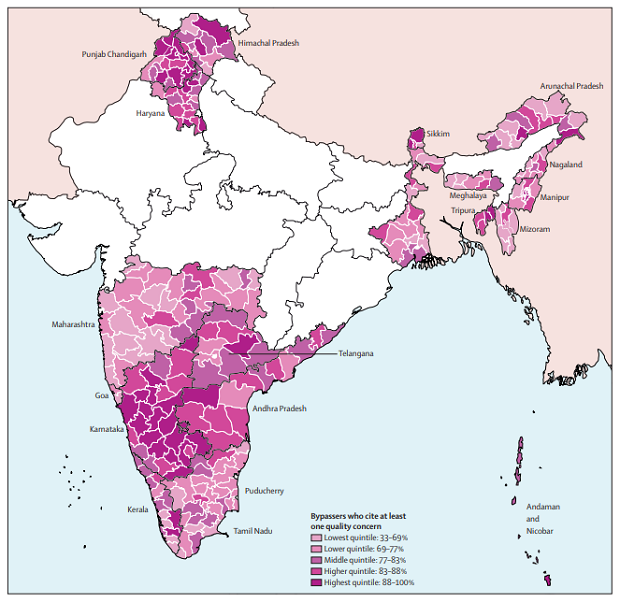
This
kind of treatment further pushes people to seek care elsewhere. Half of
households (51%) in India went to private facilities for healthcare, with 80%
citing at least one quality concern, the commission said, citing India’s District Level Household
and Facility Survey.
“Initial
and continuing professional education of health care providers must emphasise
care, concern, compassion, courtesy and respectful communication as essential
elements of health service provision--whether it is individual patients they
are dealing with in clinical care or with communities in public health,” Reddy
suggested as possible ways to reduce discrimination.
“For
this to be actualised, we need technical and financial audits to be
supplemented by social audits measuring people’s levels of satisfaction with
and utilisation of health services,” he added.
Apart
from poor quality care, insufficient access to care caused a major share of
deaths from cancer (89%), mental and neurological conditions (85%), and chronic
respiratory conditions (76%).
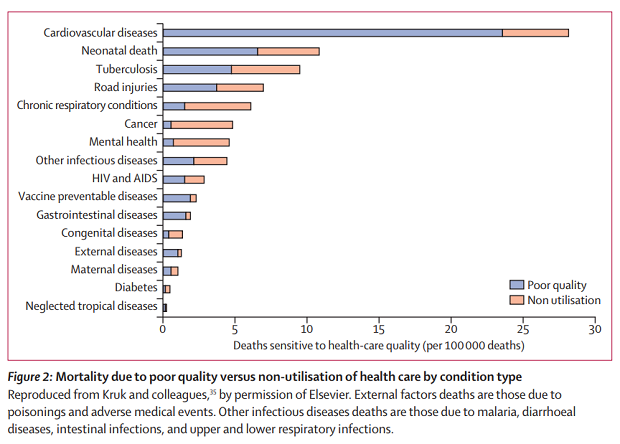
Source: The Lancet
THE
CURE :
The
situation above is sufficient to portray the need for Health Insurance in our
Lives.
Benefits
:-
- Quality
Health Care
- No need
to worry for Inflationary Medical Expenses
- Inconsistent
source of Income
- Assistance
in Retirement times.
- Income tax Benefits
- Cashless Treatment
- No
Claim Bonus
- Medical
Checkup
- Pre
and Post Hospitalization Coverage
Now
next question we have in mind is what Health Insurance to pick from the variety
of packages offered by various Insurance Companies.
Health
Insurance Companies
|
Incurred
Claim Ratio
|
Grievances
Solved
|
Network
Hospitals
|
Number
of Policies Issued
|
Number
of Persons Covered
|
Apollo Munich Health Insurance
|
62.47%
|
96.73%%
|
4500
|
809364
|
3430000
|
Bajaj Allianz General Insurance
|
66.72%
|
99.78%
|
6000
|
516178
|
11514000
|
Bharati Axa General Insurance
|
82.97%
|
99.69%
|
4500
|
20853
|
385000
|
Cholamandalam MS General Insurance
|
72.54%
|
99.55%
|
8000
|
91553
|
1854000
|
Cigna TTK Health Insurance
|
46.29%
|
99.58%
|
4000
|
176695
|
599000
|
Future Generali Health Insurance
|
75.72%
|
99.73%
|
4300
|
48113
|
6284000
|
HDFC ERGO General Insurance
|
74.36%
|
100.00%
|
8600
|
654375
|
2383000
|
ICICI Lombard General Insurance
|
76.89%
|
98.91%
|
3600
|
1014478
|
10585000
|
IFFCO Tokio General Insurance
|
82.89%
|
98.47%
|
4200
|
164998
|
20389000
|
Liberty Videocon Genral Insurance
|
69.60%
|
100.00%
|
4000
|
24728
|
552000
|
Max Bupa Health Insurance
|
50.19%
|
100.00%
|
4000
|
309909
|
2490000
|
National Health Insurance
|
114.24%
|
97.07%
|
6000
|
1807861
|
142213000
|
Reliance General Insurance
|
84.71%
|
98.49%
|
4000
|
82134
|
24516000
|
Religare Health Insurance
|
51.97%
|
99.30%
|
5420
|
437555
|
2617000
|
Royal Sundaram General Insurance
|
80.41%
|
99.74%
|
3000
|
152029
|
1081000
|
SBI General Insurance
|
71.47%
|
96.01%
|
3000
|
417400
|
5188000
|
Star
Health and Allied Insurance
|
61.76%
|
98.96%
|
8800
|
3089558
|
9040000
|
Tata- AIG General Insurance
|
71.12%
|
99.90%
|
3000
|
210310
|
824000
|
New India Assurance Health Insurance
|
85.66%
|
99.94%
|
2490
|
1747550
|
80112000
|
Oriental Health Insurance
|
85.39%
|
73.83%
|
4300
|
1322480
|
16157000
|
United India Insurance
|
56.30%
|
96.59%
|
7000
|
1230765
|
137824000
|
Universal Sompo General Insurance
|
56.30%
|
100.00%
|
7700
|
214789
|
1015000
|
Aditya Birla Health Insurance
|
89.05
|
57.54%
|
4500
|
738000
|
|
Source: IRDA Annual Report 2017-18
Star
Health stands out to be the best Health Insurance provider with the top claim
settlement ratio and having one of the highest number of Network Hospitals.
Get
yourself Insured Now :-
Comments
Post a Comment